
Construction projects rarely fail because people do not care about safety. Instead, they fail because risk is not identified early enough. This problem becomes even more serious in specialty contracting work such as electrical, HVAC, façade, fire systems, and structural installation. In these high-risk environments, pre-task planning is not a formality.
On the contrary, it is a frontline risk control system. However, many contractors still treat planning as a compliance exercise. As a result, hazards remain hidden, assumptions replace verification, and incidents happen that could have been completely avoided.
Therefore, in this complete guide, you will learn:
- What pre-task planning actually means in construction — This clarifies the real purpose of planning beyond paperwork.
- Why specialty contractors face higher risk without planning — This explains why high-risk trades need stricter daily planning.
- How planning reduces incidents before work begins — This shows how risks get eliminated before exposure happens.
- What a proper planning process looks like — This breaks the method into clear, usable steps.
- How hazard planning software improves pre-task planning — This explains how digital tools prevent weak or fake planning.
- Best practices and implementation guidance — This helps you actually make the system work on site.
By the end, you will clearly understand why planning is not optional anymore—it is operational survival.
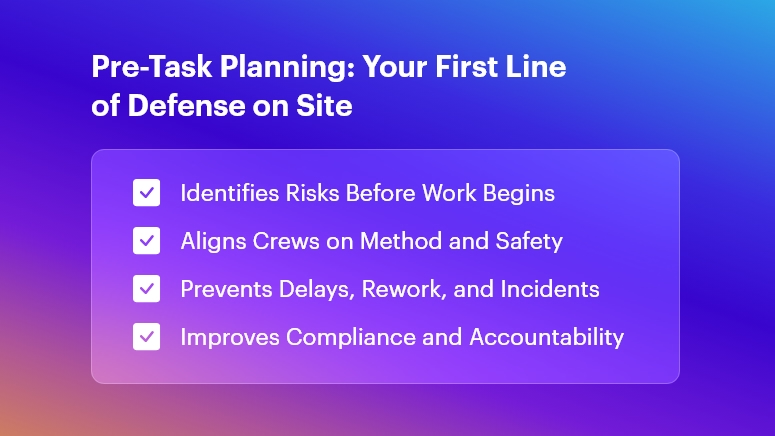
What Is Pre-Task Planning in Construction?
Pre-task planning is a structured process of identifying hazards, defining controls, and aligning the crew before any physical work begins.
In simple terms, Planning means thinking through the job before the job starts.
Instead of reacting to problems, planning forces teams to proactively:
- Break work into steps — This ensures no hidden or forgotten activity introduces unexpected risk.
- Identify hazards in each step — This makes risk visible at the exact point where it can appear.
- Decide control measures — This defines exactly how each hazard will be prevented or reduced.
- Assign responsibility — This makes sure every control has an owner, not an assumption.
- Confirm readiness — This verifies that conditions, tools, permits, and people are actually ready.
As a result, pre-task planning converts safety from a policy into a daily execution habit.
Why Specialty Contractors Need Planning More Than Anyone Else
Specialty contractors operate in the most dangerous and dynamic parts of a construction site. Their work often involves:
- Live electrical systems — These introduce fatal risk if isolation and verification fail.
- Working at height — This creates fall hazards that change daily with site conditions.
- Confined spaces — These introduce oxygen, access, and rescue risks.
- Heavy equipment interfaces — These create crush, swing, and blind-spot hazards.
- Hot work and energized systems — These introduce fire, explosion, and arc-flash risks.
- Complex trade sequencing — This creates interface hazards with other contractors.
Moreover, their work environment changes every day. Consequently, pre-task planning becomes a daily necessity, not a one-time document.
The Real Reason Accidents Still Happen
Even companies with strong safety policies still suffer incidents because:
- Safety plans stay generic — They do not reflect today’s real site conditions.
- Site conditions change daily — Yesterday’s safe plan may be dangerous today.
- Crews do not internalize risk — They follow instructions but do not own the hazards.
- Hazard identification stays at the management level — Workers face risks they did not help identify.
- Work starts before thinking finishes — Speed replaces preparation.
Pre-task planning closes this gap by moving risk thinking directly to the workforce.
How Planning Actually Reduces Incidents
Pre-task planning works because it changes behavior before exposure occurs:
- Forces hazard recognition before work starts — This prevents surprise risks during execution.
- Aligns the entire crew — Everyone starts the job with the same understanding of danger.
- Slows down rushed starts — This prevents mistakes caused by urgency and pressure.
- Catches interface conflicts early — This avoids clashes between multiple trades and activities.
- Makes safety a shared responsibility — Risk control no longer depends on one supervisor.
As a result, incidents decrease not because people become luckier, but because danger gets filtered out early.
Core Elements of an Effective Planning Process
A strong planning system always includes:
- Task breakdown — This exposes hidden or forgotten activities.
- Hazard identification — This links each step to its real risks.
- Risk assessment — This evaluates what could go wrong and how bad it could be.
- Control definition — This decides exactly how the risk will be prevented.
- Responsibility assignment — This ensures controls are not just “everyone’s job.”
- Crew sign-off — This confirms understanding and commitment before starting.
Step-by-Step: How Pre-Task Planning Should Happen on Site
A practical daily workflow looks like this:
- Review today’s scope — This ensures planning matches actual work, not assumptions.
- Break it into steps — This reveals hidden risk points.
- Identify hazards per step — This prevents missing step-specific dangers.
- Define controls — This converts awareness into protection.
- Check interfaces — This avoids conflicts with other trades and activities.
- Verify permits, tools, and conditions — This confirms real readiness.
- Get crew agreement — This ensures everyone commits before work begins.
Why Paper-Based Pre-Task Planning Fails
Paper systems usually fail because:
- Forms get filled mechanically — People focus on completion, not thinking.
- Data never gets analyzed — Repeating risks remain invisible.
- Copy-paste hides reality — Yesterday’s hazards replace today’s truth.
- Audits become performative — Compliance replaces real control.
How Hazard Planning Software Makes Pre-Task Planning Stronger
Modern hazard planning software improves planning by:
- Standardizing hazard libraries — This prevents missing known risk patterns.
- Suggesting hazards by task type — This supports less experienced supervisors.
- Blocking skipped steps — This enforces quality in the planning process.
- Allowing photo-based capture — This connects plans to real site conditions.
- Creating audit trails — This improves accountability and traceability.
- Enabling trend analysis — This helps management eliminate recurring risks.
Pre-Task Planning vs Job Safety Analysis (JSA)
- JSA is static — It describes the general risk for a type of work.
- Planning is dynamic — It addresses today’s exact conditions.
- JSA supports the system — It provides reference knowledge.
- Pre-task planning controls execution — It decides whether work starts safely today.
Real Example: Electrical Contractor in a Live Facility
Without planning:
- Isolation assumptions remain unverified — This creates hidden lethal exposure.
- Interface risks get missed — Another team’s work introduces danger.
- Live parts remain energized — A single mistake becomes fatal.
With planning:
- Isolation steps get reviewed — No assumption remains unchecked.
- Verification responsibility gets assigned — Accountability becomes clear.
- Live zones get identified and barricaded — Exposure gets eliminated before work starts.
Common Mistakes That Destroy Planning
- Forms filled after work starts — Planning loses all preventive value.
- The supervisor does it alone — Crew ownership disappears.
- Hazards copied from yesterday — Reality gets ignored.
- Controls stay vague — No one knows what to actually do.
Best Practices for High-Impact Planning
- Make it mandatory before work — This prevents rushed, unsafe starts.
- Keep it short and specific — This improves real engagement.
- Involve the entire crew — This creates shared risk ownership.
- Use hazard planning software — This enforces quality and consistency.
- Audit behavior, not paperwork — This keeps the system honest.
Benefits Beyond Safety
Planning also:
- Reduces rework — Problems get prevented instead of fixed.
- Improves coordination — Interfaces are resolved before conflicts arise.
- Prevents delays — Tools, permits, and access get verified early.
- Increases productivity — Crews work with confidence, not uncertainty.
- Reduces insurance and legal exposure — Fewer incidents mean fewer claims.
Final Conclusion
Specialty contracting will always involve risk. However, most accidents are not inevitable—they are unplanned.
And that is why pre-task planning exists.
When done properly, planning:
- Converts uncertainty into controlled execution
- Converts assumptions into verified conditions
- Converts reactive safety into proactive risk control
In modern construction, control starts before work begins. And that control is called pre-task planning.