


Construction projects in India and globally continue to face a persistent challenge: safety incidents, unplanned stoppages, and rework caused by poor pre-task planning and weak hazard identification. Industry studies repeatedly show that a significant percentage of site accidents occur due to missing or poorly executed Pre-Task Planning (PTP) and Job Hazard Analysis (JHA) processes.
In real construction environments, these gaps translate directly into schedule delays, cost overruns, lost productivity, regulatory penalties, and reputational risk.
This is where Digital PTP & JHA Solutions for Construction Teams become not just useful, but essential. As projects grow more complex — spanning multiple sites, subcontractors, and stakeholders — manual safety checklists, Excel sheets, and WhatsApp approvals simply cannot keep up.
In this blog, you will learn why digital PTP & JHA solutions for construction teams are critical in 2025, how they improve safety and execution discipline, and how modern platforms like OConstruction seamlessly integrate PTP and JHA into everyday project workflows.
Whether you are a project manager, contractor, EPC leader, or site engineer, this guide explains how to turn safety planning into a productivity and cost-control advantage.
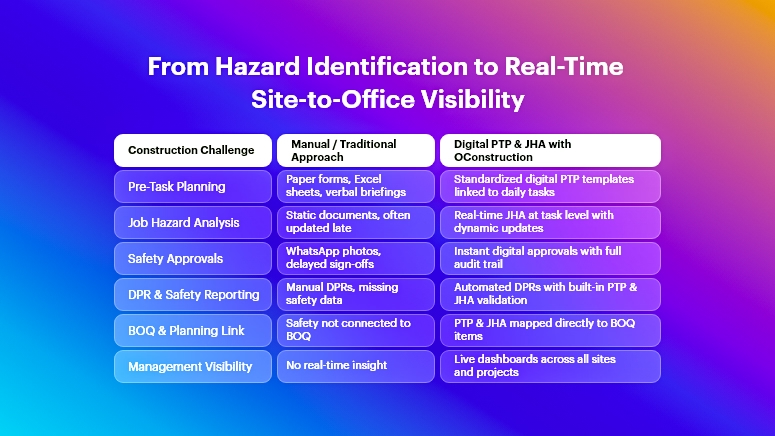
Why Digital PTP & JHA Solutions Matter in Construction
Construction is inherently high-risk. However, the real danger often lies not in the work itself, but in poor planning, fragmented communication, and inconsistent execution of safety protocols.
Across real estate, infrastructure, roads & highways, commercial projects, and EPC environments, teams face similar problems:
Unplanned site incidents and near-misses
When PTP and JHA are handled manually, hazards are often identified too late or not communicated clearly. This increases the likelihood of accidents, stoppages, and legal exposure.
Delays caused by rework and shutdowns
Safety incidents trigger inspections, work stoppages, and rework. Even a single incident can derail schedules and impact multiple dependent activities.
Disconnected documentation and approvals
PTP forms, JHA sheets, DPRs, and BOQs often live in different systems — or worse, on paper. This creates confusion, duplication, and accountability gaps.
Lack of visibility for leadership
Project heads and safety managers struggle to know whether PTP and JHA were actually completed on-site or simply ticked off for compliance.
Why Traditional Methods Fail
Relying on Excel sheets, paper checklists, WhatsApp photos, and verbal briefings fails because:
- They are not standardized, leading to inconsistent risk assessment.
- It’s not real-time, so issues surface only after damage is done.
- They do not integrate with project execution, BOQs, DPRs, or schedules.
- It depends heavily on human discipline, which breaks down under pressure.
Therefore, digital PTP & JHA solutions for construction teams are no longer optional. They create speed, accuracy, traceability, and accountability, while embedding safety directly into execution workflows.
1. Standardize Pre-Task Planning Across All Sites
Create standardized digital PTP templates
Define activity-wise PTP formats for excavation, formwork, concreting, lifting operations, electrical work, and finishing. Digital templates ensure consistency across projects and contractors.
Link PTP to daily work plans
Each day’s planned activities in OConstruction automatically trigger the relevant PTP checklist, ensuring no work starts without proper planning.
Ensure mandatory digital sign-offs
Site engineers, safety officers, and supervisors digitally approve PTPs, creating a clear audit trail.
2. Digitize Job Hazard Analysis (JHA) at the Task Level
Identify hazards before work begins
Digital JHA allows teams to document hazards related to equipment, materials, environment, and manpower before execution.
Define control measures clearly
Each identified hazard must include preventive and corrective actions, PPE requirements, and responsible persons.
Update JHA dynamically
As site conditions change, JHA can be revised instantly without reprinting or resubmitting documents.
3. Integrate PTP & JHA with BOQ and Planning
Align safety planning with BOQ items
Each BOQ activity should map to its corresponding PTP and JHA, preventing scope blind spots.
Prevent cost leakage due to unsafe execution
Unsafe work leads to material wastage, rework, and equipment damage — directly impacting budgets.
Improve estimation accuracy
Historical PTP and JHA data help planners factor realistic durations and safety buffers into future BOQs.
4. Automate DPRs with Safety Validation
Capture PTP & JHA completion in DPRs
Daily Progress Reports should automatically reflect whether safety checks were completed for executed activities.
Enable real-time site-to-office sync
Project leadership gets instant visibility into safety compliance across all sites.
Reduce manual reporting errors
Automated DPRs eliminate inconsistent or fabricated safety reporting.
5. Strengthen Material, Labor & Equipment Safety
Track labor skill and certification
Assign tasks only to workers trained and authorized for specific activities.
Monitor equipment readiness
Digital checks ensure lifting equipment, tools, and machinery meet safety standards before use.
Reduce unsafe shortcuts
When material availability, schedules, and labor planning are visible, teams are less likely to cut corners.
6. Common Mistakes Construction Teams Must Avoid
Treating PTP & JHA as paperwork
Digital systems must drive behavior, not just compliance.
Failing to train site teams
Adoption requires onboarding engineers, supervisors, and contractors—not just management.
Not linking safety to execution data
Safety data must connect to schedules, costs, and performance metrics.
Construction Success Story
For example, a mid-sized infrastructure and road construction company, adopted Digital PTP & JHA Solutions for Construction Teams using OConstruction to address recurring site incidents and reporting delays.
Before implementation, PTP and JHA were handled through paper forms and Excel sheets, often completed after work had already started. DPRs lacked safety validation, and leadership had limited site visibility.
Within three months, the transformation was clear:
- 30% reduction in safety-related stoppages
- 40% faster DPR completion with automated safety logs
- Improved BOQ accuracy due to reduced rework
- Clear accountability across supervisors and subcontractors
- Real-time visibility for project managers across multiple sites
By embedding digital PTP and JHA into daily workflows, the company turned safety planning into a driver of execution discipline and cost control.
Key Takeaways & Closing
Digital transformation in construction is no longer limited to planning and billing — it must extend to how work is prepared and executed safely on-site.
The most successful teams understand that Digital PTP & JHA Solutions for Construction Teams are not just safety tools; they are productivity, cost-control, and governance enablers.
Key takeaways:
- Manual PTP & JHA processes increase risk, delays, and cost leakage
- Digital workflows improve visibility, accountability, and execution speed
- Integrated platforms like OConstruction connect safety with BOQ, DPR, and schedules
- Early adoption leads to measurable gains in time, cost, and safety outcomes
Construction teams that digitize today will be better prepared for larger projects, stricter compliance, and tighter margins tomorrow.
FAQs
1. What are Digital PTP & JHA Solutions for Construction Teams?
They are software-driven systems that digitize Pre-Task Planning and Job Hazard Analysis, integrating safety planning directly into construction workflows.
2. Why are digital PTP & JHA solutions better than manual methods?
They provide real-time visibility, standardized processes, automated reporting, and stronger accountability across sites.
3. Can digital PTP & JHA integrate with BOQ and DPR workflows?
Yes. Platforms like OConstruction link PTP and JHA directly with BOQs, schedules, and DPR automation.
4. Do digital PTP & JHA solutions help reduce project delays?
Absolutely. By preventing incidents and rework, teams experience fewer stoppages and more predictable execution.
5. Are digital PTP & JHA solutions suitable for small contractors?
Yes. They scale easily and reduce dependence on paperwork, making them valuable for both small and large projects.
6. How quickly can teams adopt digital PTP & JHA?
With proper onboarding, most teams see adoption within weeks and measurable benefits within a few months.