

The construction industry is entering one of the most regulated and scrutinized eras in its history. As projects become larger, supply chains become more complex, and governments tighten oversight, construction compliance is no longer just a legal formality — it is now a core business strategy.
In 2026, companies that treat compliance as a checklist will struggle. Meanwhile, companies that treat compliance as a system will scale faster, avoid penalties, and win more enterprise-grade contracts.
More importantly, compliance now touches every layer of a construction business: labor, safety, finance, environment, data, contracts, and reporting. Therefore, understanding the top construction compliance requirements in 2026 is not optional — it is operational survival.
In this complete guide, you will learn:
- What compliance really means in 2026
- Why are regulations becoming stricter every year
- The most critical compliance areas you must cover
- How to build a scalable compliance system
- How technology simplifies compliance
By the end, you will have a single, comprehensive reference instead of hunting across dozens of sources.
What Construction Compliance Really Means in 2026
Construction compliance means adhering to all legal, regulatory, contractual, safety, environmental, and financial requirements that govern how construction projects operate.
However, in 2026, compliance is no longer:
- Just about permits
- Just about safety helmets
- Just about inspections
Instead, compliance now means:
- Proving compliance continuously
- Documenting everything digitally
- Passing audits at any time
- Enforcing policies across all projects and sites
In other words, compliance has shifted from paperwork to systems.
Why Construction Compliance Is Getting Stricter Every Year
Three major forces are driving stricter compliance:
- First, governments want more transparency in labor, taxation, and safety.
- Second, enterprise clients want zero-risk vendors.
- Third, insurers want verifiable risk controls before issuing policies.
As a result, compliance in 2026 now focuses on:
- Real-time reporting
- Digital audit trails
- Cross-department data consistency
- Zero-tolerance safety enforcement
The Top Construction Compliance Requirements in 2026
Let us now break down the most important compliance areas you must master.
1. Labor Law and Workforce Compliance
Labor compliance is now the most audited area in construction.
In 2026, compliance requires:
- Proper worker classification (employee vs contractor)
- Verified wage structures and overtime rules
- PF, ESI, gratuity, and statutory contributions
- Working hours and shift compliance
- Leave and attendance traceability
If your labor data is inconsistent across HR, payroll, and site records, your construction compliance risk increases immediately.
This is why modern compliance starts with centralized workforce systems.
2. Site Safety and Health Compliance
Safety is no longer just operational — it is legal, contractual, and insurable.
Construction compliance in safety now requires:
- Daily safety logs
- Digital incident reporting
- PPE compliance records
- Safety training certifications
- Toolbox talk documentation
Moreover, inspectors increasingly expect timestamped, location-based proof rather than manual registers.
Therefore, compliance in safety is now evidence-driven, not excuse-driven.
3. Environmental and Sustainability Compliance
In 2026, environmental construction compliance is non-negotiable, especially for urban and government projects.
You must comply with:
- Waste disposal regulations
- Dust and noise pollution limits
- Water usage and discharge norms
- Material sourcing rules
- Carbon and sustainability reporting
Additionally, many contracts now include environmental compliance clauses with penalties.
Thus, environmental compliance directly affects profitability.
4. Contractual and Documentation Compliance
Most construction disputes are not operational — they are documentation failures.
Construction compliance in contracts includes:
- Proper version control of drawings and BOQs
- Change order approvals
- Scope variation documentation
- Subcontractor agreement tracking
- Claim and extension records
In 2026, if it is not documented, it legally does not exist.
Therefore, compliance requires document discipline across the project lifecycle.
5. Financial, Tax, and Billing Compliance
Financial construction compliance is now under continuous digital scrutiny.
This includes:
- GST/VAT and tax filings
- TDS and withholding compliance
- Vendor payment traceability
- Expense documentation
- Audit-ready financial records
Since governments increasingly use data matching systems, even small inconsistencies can trigger large investigations.
That is why compliance and accounting systems must stay perfectly aligned.
6. Licensing, Permits, and Regulatory Approvals
Operating without valid permits is one of the fastest ways to shut down a project.
Construction compliance requires:
- Valid contractor licenses
- Trade-specific certifications
- Local authority permits
- Periodic renewals and inspections
- Occupancy and completion certificates
More importantly, modern construction compliance requires renewal tracking and expiry alerts, rather than manual reminders.
7. Equipment and Machinery Compliance
Heavy equipment now falls under strict safety and inspection regimes.
Construction compliance includes:
- Fitness certificates
- Operator certifications
- Maintenance logs
- Load testing records
- Insurance coverage
In 2026, site accidents involving non-compliant equipment attract both criminal and financial liability.
8. Data Protection and Digital Compliance
As construction companies digitize, data compliance becomes an integral part of overall construction compliance.
This includes:
- Employee data protection
- Client data security
- Access control systems
- Audit logs
- Backup and retention policies
Losing project data is no longer an IT issue — it is a compliance failure.
Why Construction Compliance Fails in Most Companies
Despite good intentions, compliance fails because:
- Data lives in silos
- Sites operate independently
- Documentation happens after the fact
- Audits become panic-driven exercises
- Compliance becomes reactive, not proactive
In short, most companies manage compliance manually in a digital world.
The Shift: From Compliance as a Task to Compliance as a System
In 2026, smart companies build compliance into daily operations.
They:
- Integrate HR, payroll, projects, and finance
- Enforce digital workflows
- Generate audit trails automatically
- Monitor risk in real time
As a result, compliance becomes continuous and invisible, not painful and disruptive.
How Technology Is Reshaping Construction Compliance
Modern construction platforms now:
- Track attendance and wages
- Enforce safety checklists
- Store documents centrally
- Generate compliance reports
- Provide audit-ready dashboards
This is why compliance software is no longer optional—it is strategic infrastructure.
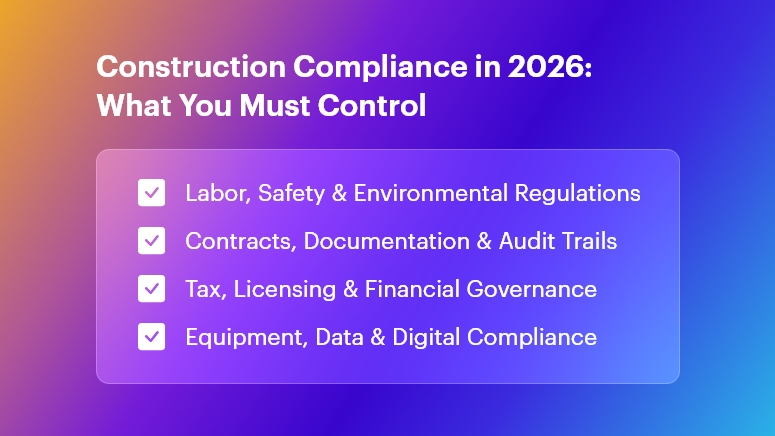
A Practical Construction Compliance Checklist for 2026
Here is a high-level summary:
- Labor and payroll compliance
- Safety and health compliance
- Environmental compliance
- Contract and documentation compliance
- Financial and tax compliance
- Licensing and permits
- Equipment compliance
- Data and digital compliance
If even one of these areas is weak, your entire compliance posture collapses.
The Business Benefits of Strong Construction Compliance
When you master compliance:
- You win bigger contracts
- You pass audits confidently
- You reduce legal risk
- You improve operational discipline
- You build long-term credibility
In other words, compliance becomes a growth engine, not a cost center.
Final Thoughts: Construction Compliance Is the New Competitive Advantage
In 2026, construction companies will not compete only on cost, speed, or scale.
They will compete on trust, governance, and compliance maturity.
The companies that invest early in system-driven compliance will:
- Scale faster
- Survive audits easily
- Attract better clients
- Operate with lower risk
Ultimately, compliance is no longer about avoiding penalties.
It is about building a future-proof construction business.