

Construction does not fail in planning rooms. It fails on job sites. Most delays, cost overruns, rework, safety incidents, and disputes happen in the field. Yet, for decades, construction field teams have relied on paper, phone calls, WhatsApp messages, and disconnected tools. As a result, information gets lost, decisions get delayed, and accountability disappears. This is exactly why construction field apps have become a strategic necessity rather than just a technology upgrade.
Today, projects are larger, timelines are tighter, and compliance is stricter. Therefore, companies that still run their field operations manually lose control long before they realize it. On the other hand, companies that adopt field apps gain real-time visibility, execution speed, and operational discipline.
In this complete guide, you will learn:
- What field apps really are
- Why field apps matter in modern projects
- The top 10 benefits of apps for field teams
- How field apps improve productivity, quality, safety, and profitability
- What to look for when choosing the right construction field app
What Are Construction Field Apps?
Construction field apps are mobile applications designed specifically for on-site teams to manage daily operations digitally.
These apps typically cover:
- Daily reporting
- Task execution
- Timesheets
- Inspections and checklists
- Drawings and documents
- Safety meetings
- Issue tracking
- Material tracking
- Communication and approvals
Instead of running site operations on paper and memory, field apps turn the job site into a real-time, connected execution environment.
Why Traditional Field Management Fails
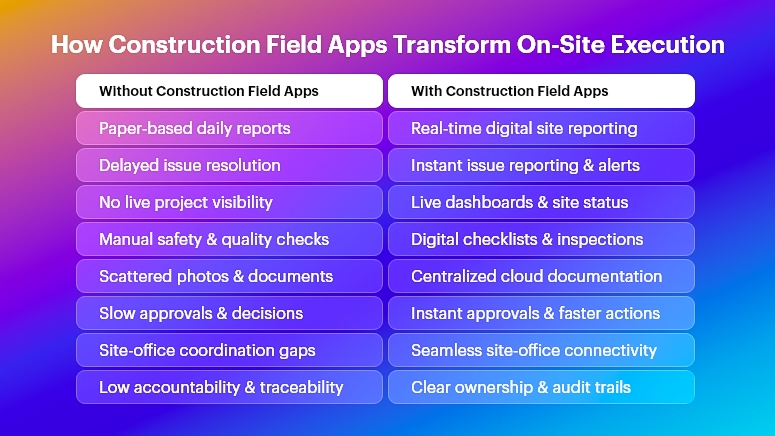
Before we look at the benefits, it is important to understand why manual field operations break down:
- Information travels slowly
- Reports get delayed or manipulated
- Site progress stays invisible to management
- Mistakes get discovered too late
- Accountability becomes unclear
- Rework increases
- Safety compliance becomes reactive
- Costs quietly leak
Therefore, modern construction simply cannot scale without construction field apps.
Top 10 Benefits of Field Apps
1. Real-Time Site Visibility
The biggest benefit of field apps is real-time visibility.
Instead of waiting for end-of-day or end-of-week reports, management can see:
- What is happening on site
- Which tasks are completed
- How many issues are blocking work
- What resources are being used
As a result, decisions become proactive instead of reactive. Moreover, leadership no longer manages projects blindly.
In short, field apps convert job sites into live operational dashboards.
2. Faster Decision-Making
When information flows in real time, decisions naturally become faster.
With field apps:
- Engineers upload site issues instantly
- Supervisors get immediate notifications
- Managers approve or redirect work without delay
Therefore, projects stop waiting for meetings, emails, or phone calls. Instead, execution continues without interruption.
3. Higher Construction Labor Productivity
One of the most measurable benefits of field apps is improved productivity.
These apps:
- Reduce idle time
- Eliminate repeated explanations
- Remove confusion about priorities
- Prevent rework due to outdated instructions
As a result, crews spend more time building and less time waiting, clarifying, or fixing mistakes.
In practical terms, construction field apps directly increase output per labor hour.
4. Standardized Daily Reporting
Manual reporting is inconsistent, delayed, and often inaccurate.
However, construction field apps enforce:
- Structured daily logs
- Standard formats
- Photo evidence
- Time-stamped entries
Because of this, management finally gets reliable data from every site, every day, without chasing anyone.
5. Better Quality Control
Quality problems rarely come from bad intent. Instead, they come from:
- Missed checks
- Unclear specifications
- Unrecorded deviations
With field apps, teams can:
- Run digital checklists
- Perform inspections in real time
- Attach photos and notes
- Raise NCRs immediately
Consequently, quality becomes a continuous process instead of a final-stage firefight.
6. Stronger Safety Compliance
Safety cannot depend on memory or paperwork.
Construction field apps make safety systematic by enabling:
- Digital safety meetings
- Toolbox talks
- Incident reporting
- Hazard observations
- Compliance checklists
As a result, safety becomes part of daily execution rather than an afterthought.
Moreover, audit readiness improves automatically.
7. Elimination of Paper and Data Loss
Paper-based systems fail because:
- Paper gets lost
- Photos stay in personal phones
- Notes never reach the office
- Records cannot be searched
field apps solve this permanently by:
- Storing everything in the cloud
- Linking data to projects and dates
- Making records instantly searchable
- Preserving history for audits and claims
8. Better Coordination Between Site and Office
One of the biggest operational gaps in construction is the site-office disconnect.
Construction field apps close this gap by:
- Syncing site data instantly
- Giving office teams live progress visibility
- Allowing faster billing, planning, and procurement decisions
Therefore, the entire organization starts operating as one connected system instead of isolated silos.
9. Stronger Accountability and Ownership
When everything is recorded digitally:
- Responsibilities become clear
- Timelines become visible
- Delays become traceable
Because of this, field apps naturally improve ownership without micromanagement.
In other words, transparency drives discipline.
10. Better Cost Control and Higher Profitability
Finally, all the above benefits lead to the most important outcome: financial control.
Construction field apps help reduce:
- Rework
- Delays
- Claims
- Idle labor
- Material wastage
- Compliance penalties
As a result, margins improve not by cutting corners, but by eliminating operational inefficiency.
Additional Strategic Benefits of Field Apps
Beyond the core benefits, construction field apps also enable:
- Faster project onboarding
- Easier scaling across multiple sites
- Better dispute resolution
- Stronger client reporting
- Improved brand credibility
What to Look for in a Construction Field App
When choosing among field apps, ensure it supports:
- Daily reports and logs
- Task and issue tracking
- Drawings and documents
- Inspections and checklists
- Safety workflows
- Offline mode
- Role-based access
- Real-time dashboards
Most importantly, the app must be simple for field teams. If the site team does not use it, nothing else matters.
The Real Business Impact of Field Apps
Companies that successfully implement field apps typically experience:
- 15–30% improvement in execution speed
- 20–40% reduction in rework
- Massive improvement in reporting accuracy
- Stronger control across multiple projects
More importantly, they move from reactive firefighting to proactive management.
Final Thoughts: The Future of Construction Runs on Field Apps
Construction is no longer just about building structures. It is about managing information, coordination, risk, and execution speed.
In that world, field apps are not optional anymore. They are the operating systems of modern construction companies.
If you want predictable delivery, controlled costs, and scalable operations, your journey must start with implementing the right construction field apps across your field teams.
Suggest 10 FAQs
1. What are field apps?
Field apps are mobile applications designed for on-site teams to manage daily construction activities such as reporting, inspections, task tracking, safety meetings, documentation, and communication in real time.
2. Why are construction field apps important for modern projects?
Construction apps are important because they provide real-time visibility, improve productivity, reduce delays, enhance quality control, strengthen safety compliance, and eliminate manual paperwork from job sites.
3. Can field apps work without internet connectivity?
Yes, most modern construction apps offer offline functionality. Field teams can continue working without the internet, and the data automatically syncs once connectivity is restored.
4. How do field apps improve construction labor productivity?
Construction apps improve labor productivity by reducing idle time, preventing rework, clarifying task priorities, improving coordination, and eliminating time wasted on manual reporting and follow-ups.
5. Are construction apps suitable for small and mid-sized contractors?
Yes, construction field apps are highly beneficial for small and mid-sized contractors because they standardize processes, improve control, reduce operational chaos, and help scale operations without increasing overhead.
6. What features should I look for in construction apps?
You should look for features like daily reports, task management, issue tracking, inspections, safety workflows, document management, photo uploads, offline access, and real-time dashboards.
7. Do construction apps replace project management software?
Field apps do not replace full project management software. Instead, they complement it by digitizing field execution and ensuring accurate, real-time data flows from the site to the management system.
8. How do construction apps help with safety compliance?
field apps help with safety compliance by enabling digital safety meetings, toolbox talks, hazard reporting, incident tracking, inspection checklists, and audit-ready documentation.
9. Are construction field apps difficult for site teams to use?
No, good field apps are designed to be simple and mobile-friendly. Most field teams can start using them with minimal training, especially if the interface is built specifically for site workflows.
10. What is the ROI of implementing field apps?
The ROI of construction field apps usually comes from reduced rework, fewer delays, better labor utilization, improved reporting accuracy, stronger compliance, and better overall project control, leading to higher profitability.