


Construction projects don’t fail because of bad ideas. They fail because construction labor productivity breaks down on-site.
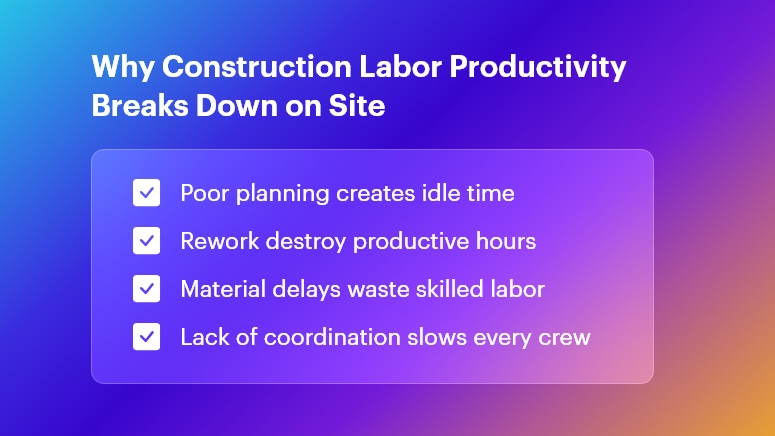
Dead time increases.
Rework piles up.
Skilled labor gets wasted on low-value tasks.
As a result, timelines stretch, costs rise, and margins shrink.
However, improving labor productivity isn’t about pushing workers harder. Instead, it’s about removing friction, improving flow, and enabling teams to do their best work — every single day.
In this guide, you’ll learn exactly how to improve labor productivity on construction sites, using proven, real-world strategies. More importantly, this article covers everything in one place, so you won’t need to jump between sources.
What Is Construction Labor Productivity?
Labor productivity measures how efficiently labor hours convert into completed work.
In simple terms:
Construction labor productivity = Output ÷ Labor input
For example, if a crew installs more square feet of concrete using the same labor hours, productivity improves.
However, productivity isn’t only about speed. Instead, it also includes:
- Work quality
- Resource utilization
- Downtime reduction
- Safety compliance
- Rework prevention
Therefore, improving labor productivity means improving the entire site ecosystem, not just worker speed.
Why Construction Labor Productivity Matters More Than Ever
Today, construction faces tighter margins, labor shortages, and rising material costs. Because of this, labor productivity has become a survival metric—not a nice-to-have.
Here’s why it matters:
- Labor accounts for 30–50% of the total project cost
- Even a 10% productivity improvement can significantly boost profits
- Poor productivity directly causes delays, disputes, and penalties
As a result, companies that actively improve construction labor productivity consistently outperform competitors.
Common Causes of Low Construction Labor Productivity
Before fixing productivity, you must understand what’s breaking it.
Most sites struggle with the same issues.
1. Poor Planning and Scheduling
When tasks aren’t clearly sequenced, crews wait.
When materials arrive late, labor stands idle.
Consequently, productivity collapses.
2. Lack of Skilled Labor
Untrained or mismatched labor increases mistakes.
Rework then eats into productive hours.
3. Inefficient Communication
Instructions change.
Drawings get outdated.
Supervisors repeat explanations.
As a result, confusion kills momentum.
4. Excessive Rework
Every rework hour is negative productivity.
Yet, many sites accept it as normal.
5. Unsafe Work Conditions
Accidents slow everything down.
More importantly, unsafe sites suffer morale loss, absenteeism, and stoppages.
How to Improve Construction Labor Productivity: Proven Strategies
Now let’s get practical.
Below are proven, field-tested ways to improve labor productivity, organized from planning to execution.
1. Improve Pre-Construction Planning
Productivity starts before boots hit the site.
When planning is weak, labor productivity never recovers.
Strong planning improves construction labor productivity by reducing uncertainty.
Focus on:
- Detailed work breakdown structures
- Clear task sequencing
- Realistic labor estimates
- Risk-based scheduling
Moreover, involve site supervisors early. Their experience prevents theoretical plans from failing on the ground.
2. Use Short-Interval and Daily Planning
Long schedules look good on paper.
However, daily plans drive real labor productivity.
- Therefore, break work into:
- Daily goals
- Crew-level assignments
- Measurable outputs
This approach ensures workers always know what success looks like today, not just this month.
3. Match the Right Skill to the Right Task
One of the fastest ways to improve construction labor productivity is proper skill allocation.
Highly skilled workers should never waste time on low-value tasks.
Instead:
- Assign skilled labor to critical activities
- Delegate support tasks to helpers
- Rotate roles strategically
As a result, output increases without adding headcount.
4. Reduce Non-Productive Time on Site
Non-productive time is the silent killer of labor productivity.
This includes:
- Waiting for materials
- Searching for tools
- Repeating instructions
- Idle time between tasks
To fix this:
- Stage materials close to work zones
- Standardize tool locations
- Pre-brief crews before shifts
Even small reductions here lead to massive productivity gains.
5. Leverage Construction Technology
Technology no longer replaces labor—it multiplies productivity.
Modern tools dramatically improve construction labor productivity by improving visibility and coordination.
Key technology areas include:
- Digital scheduling
- Workforce tracking
- Real-time progress reporting
- Mobile site communication
Because of this, supervisors spend less time managing chaos and more time enabling progress.
6. Standardize Work Processes
Consistency improves speed.
When crews repeat standardized processes, productivity rises naturally.
To standardize:
- Document best practices
- Use repeatable workflows
- Train crews on standard methods
Over time, this creates predictable, measurable labor productivity.
7. Invest in Training and Upskilling
Untrained labor costs more than trained labor.
Although training requires upfront investment, it delivers long-term productivity gains.
Focus on:
- Skill-specific training
- Safety education
- Equipment handling
- Productivity benchmarks
As skills improve, construction labor productivity improves without increasing hours.
8. Improve Site Communication
Clear communication eliminates confusion.
Therefore, to improve labor productivity, communication must be:
- Visual
- Simple
- Consistent
Use daily toolbox talks, visual boards, and real-time updates to keep everyone aligned.
9. Monitor Productivity in Real Time
You can’t improve what you don’t measure.
Tracking labor productivity daily helps identify problems early.
Key metrics include:
- Output per labor hour
- Crew efficiency rates
- Downtime reasons
- Rework percentages
With real-time insights, corrective action becomes faster and more effective.
10. Focus on Safety First
Safe sites are productive sites.
Accidents disrupt workflow, damage morale, and reduce trust.
To protect labor productivity:
- Enforce safety standards
- Conduct regular safety audits
- Empower workers to report hazards
When workers feel safe, productivity follows naturally.
11. Motivate and Engage the Workforce
Motivation directly impacts labor productivity.
Engaged workers care about output, quality, and timelines.
Effective motivation strategies include:
- Performance-based incentives
- Clear career paths
- Recognition for high productivity
- Transparent communication
As engagement increases, absenteeism drops, and productivity improves.
12. Minimize Rework Through Quality Control
Rework is the enemy of productivity.
Therefore, improving quality directly improves construction labor productivity.
Implement:
- First-time-right inspections
- Clear quality standards
- Supervisor sign-offs
As a result, crews move forward instead of fixing old mistakes.
How to Measure Construction Labor Productivity Accurately
Accurate measurement is essential.
Use these formulas and methods:
- Output per man-hour
- Earned value analysis
- Planned vs actual labor hours
- Crew-level productivity tracking
When measurement is consistent, improvement becomes predictable.
Final Thoughts: Productivity Is a System, Not a Shortcut
Improving construction labor productivity isn’t about pressure.
It’s about process, planning, and people.
When you remove friction, align teams, and support workers with the right tools, productivity improves naturally.
Most importantly, companies that treat construction labor productivity as a strategic priority consistently deliver projects faster, safer, and more profitably.