



Construction does not fail in boardrooms. It fails in the field. Most delays, rework, cost overruns, and disputes originate where work actually happens — on construction sites.
Yet, for decades, field teams have worked with paper, phone calls, WhatsApp messages, and disconnected tools. That approach might have worked when projects were smaller and simpler. However, today’s construction environment is larger, faster, and far more complex.
That is exactly why construction field apps have become a strategic necessity rather than a technology upgrade.
In modern construction, speed of information matters as much as speed of execution. Therefore, companies that still rely on manual reporting and fragmented communication lose control long before they see the problem.
This is where field apps fundamentally change how projects operate.
In this comprehensive guide, you will learn:
- What construction field apps really are
- Why traditional field operations fail at scale
- What problems do field apps solve
- How field apps transform productivity, quality, safety, and cost control
- How to choose the right construction field app for your organization
What Are Construction Field Apps?
Construction field apps are mobile applications designed specifically for site teams — engineers, supervisors, foremen, safety officers, and project managers — to capture, access, and act on project data directly from the field.
Instead of waiting to return to the office, field teams can:
- Report progress in real time
- Update daily logs and site diaries
- Upload photos and videos
- Raise issues and RFIs
- Track labor, materials, and equipment
- Access drawings and checklists
In short, field apps bring the entire project management system into the worker’s pocket.
Why Traditional Field Operations Break Down
Before we discuss the benefits, it is important to understand why old field workflows no longer work.
Most construction sites still suffer from:
- Paper-based reporting
- Delayed data entry
- Verbal instructions and follow-ups
- Scattered photos and documents
- No single source of truth
As a result:
- Managers get the information too late
- Errors remain hidden until they become expensive
- Accountability becomes unclear
- Decisions are based on outdated data
Therefore, the real problem is not labor, material, or planning. The real problem is information latency.
And that is exactly the gap construction field apps eliminate.
The Core Need of Construction Field Apps in Modern Projects
The need for construction field apps comes from one simple reality.
You cannot control what you cannot see in real time.
Modern construction demands:
- Faster decisions
- Tighter margins
- Higher quality
- Stronger compliance
- Better coordination
All of this is impossible if the field operates in isolation from the system.
How Construction Field Apps Transform Field Operations
Let us now examine exactly how construction field apps change day-to-day site execution.
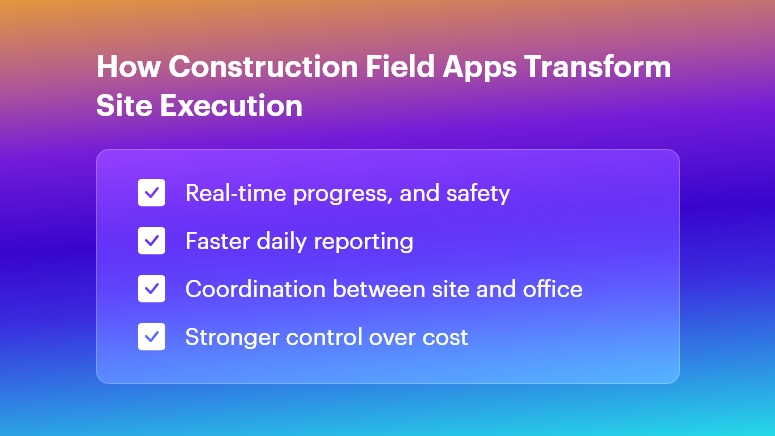
1. Real-Time Project Visibility
First and foremost, field apps eliminate reporting delays.
Instead of waiting for end-of-day or end-of-week updates:
- Site teams update progress instantly
- Managers see live dashboards
- Issues appear the moment they occur
- Decisions happen faster
This single change:
- Reduces surprises
- Improves predictability
- Increases control across projects
2. Faster and More Accurate Daily Reporting
Daily Progress Reports (DPRs) are the heartbeat of project control. Unfortunately, manual DPRs are:
- Time-consuming
- Often inaccurate
- Frequently delayed
- Difficult to analyze
With field apps, teams can:
- Fill DPRs on-site
- Auto-capture photos and quantities
- Standardize reporting formats
- Eliminate duplicate data entry
As a result:
- Reporting becomes consistent
- Data becomes reliable
- Management gains real operational insight
3. Better Quality Control and Fewer Rework Cycles
Quality failures are rarely intentional. Most of the time, they happen because:
- Checklists are not followed
- Inspections are not documented
- Issues are not tracked to closure
Field apps solve this by enabling:
- Digital quality checklists
- On-site inspections with photo evidence
- Snag and punch list tracking
- Clear issue ownership and status
Therefore:
- Defects get caught early
- Rework reduces
- Client satisfaction improves
- Project margins stay protected
4. Stronger Safety Compliance and Incident Tracking
Safety cannot depend on memory or paperwork.
With field apps, companies can:
- Run daily safety checklists
- Log near-misses and incidents instantly
- Attach photos and location data
- Track corrective actions to closure
- Maintain audit-ready safety records
This leads to:
- Better safety culture
- Lower accident rates
- Stronger legal and compliance protection
5. Seamless Communication Between Site and Office
One of the biggest operational gaps in construction is site – office disconnect.
Construction field apps create a single communication layer where:
- Site updates flow instantly to the office
- Office instructions reach the field immediately
- Everyone works from the same data
This reduces:
- Phone call dependency
- WhatsApp chaos
- Misinterpretation of instructions
- Version conflicts in drawings and documents
6. Labor, Material, and Equipment Tracking
Cost overruns often begin with poor site-level visibility.
With field apps, teams can:
- Record labor deployment daily
- Track material consumption
- Log equipment usage and downtime
- Compare planned vs actuals continuously
Therefore:
- Cost leakage becomes visible early
- Productivity issues surface faster
- Corrective actions happen on time
7. Better Accountability and Ownership
When everything happens verbally, nothing is truly owned.
Construction field apps introduce:
- Named responsibility
- Timestamped actions
- Photo-backed evidence
- Status tracking
As a result:
- Accountability improves
- Follow-ups become systematic
- Execution discipline increases
8. Standardization Across All Projects and Sites
Growing construction companies struggle with process inconsistency.
Field apps solve this by:
- Enforcing standard formats
- Using uniform checklists and workflows
- Applying the same reporting structure everywhere
This creates:
- Predictable execution
- Easier audits
- Faster onboarding of new teams
Key Use Cases of Construction Field Apps
In practice, construction field apps are used for:
- Daily progress reporting
- Site diaries and logs
- Quality inspections and checklists
- Safety audits and incident reporting
- Snag and punch list management
- Photo documentation
- Drawing access and markups
- Labor and material tracking
The Business Impact of Construction Field Apps
Companies that successfully implement construction field apps consistently achieve:
- Higher project predictability
- Lower rework and waste
- Faster issue resolution
- Better margin control
- Stronger client confidence
More importantly, leadership finally gains true operational visibility instead of depending on lagging reports.
How to Choose the Right Construction Field App
When evaluating solutions, focus on:
- Simplicity for site users
- Offline functionality
- Fast photo and data capture
- Workflow flexibility
- Integration with project management systems
- Strong reporting and analytics
Remember: If site teams find the app difficult, they will not use it.
The Future of Construction Belongs to Mobile-First Execution
Construction is moving toward:
- Real-time project control
- Data-driven execution
- Predictive risk management
- Fully connected job sites
At the center of this shift are construction field apps.
Soon, companies that still rely on manual field processes will not just be slower — they will be uncompetitive.
Final Thoughts
To conclude, the need for construction field apps is not about convenience. It is about control, speed, quality, and profitability.
Projects succeed or fail in the field. Therefore, the field must operate on real-time systems, not delayed paperwork.
In the modern construction industry:
“If your field is not digital, your management is blind.”
And that is why construction field apps are no longer optional — they are foundational.